
In June 2026, the National Centre for Foreign Languages (NCFF) published the report 13 recommendations for foreign languages in the future. This is the centre’s final publication and a compilation of the knowledge and experience accumulated through the NCFF’s work from 2018 to 2026. With 13 recommendations and a number of concrete proposals for action, the report looks to the future and raises the question of how the field of foreign languages in Denmark can be strengthened in the coming years.

The report takes a serious tone. Among other things, it highlights declining interest and enrolment across the education system, the risk of a shortage of qualified language teachers, and challenges regarding the coherence between the different levels of the education system. At the same time, the report takes a broader perspective: foreign language skills are significant not only for the education system, but also for Denmark’s international relations, the business sector, cultural enrichment and opportunities to operate in an increasingly complex world.
A key perspective in the report is that the field of foreign languages should be regarded as a unified ecosystem. Developments at one level of education have consequences for subsequent levels. For example, the opportunities to choose specific foreign languages in primary and lower secondary school affect the student intake in upper secondary school and, in the longer term, recruitment to teacher training programmes and university language courses.
Three areas and 13 recommendations
The recommendations are grouped into three broad areas: system and structure, content and curriculum, and skills development.
In the area of system and structure, recommendations include, amongst other things, better opportunities to choose languages, a strengthening of work placements in teacher training, and a rethinking of upper secondary school teacher training. The report thus highlights structural issues that extend beyond individual language subjects and individual educational institutions.
Another key area is the content and curriculum of language subjects. The report points to a mismatch between what children and young people would like to be able to do with foreign languages, and parts of the teaching and examination formats they encounter. The desire to be able to communicate and use the language in authentic contexts is not necessarily matched by a curriculum and examination formats that adequately support this.

Against this background, the report recommends, amongst other things, a rethinking of the content and assessment methods of language subjects and language programmes, greater visibility of the opportunities offered by strong language skills, and closer collaboration between university language programmes and businesses, cultural institutions and public sector organisations. The report also highlights opportunities to re-establish and rethink higher education combined degree programmes in which languages are integrated with other disciplines.
The third area concerns professional development. Here, professional development initiatives are recommended for language teachers and tutors, as well as for foreign language teaching advisors and coordinators, and for local, municipal and regional networks. At the same time, it is emphasised that professional development cannot stand alone if the challenges are also structural.
Across the recommendations, a number of recurring questions thus emerge: How can greater coherence be created in foreign language teaching across the education system? What should language subjects encompass in the future? How can the link between linguistic expertise and other educational programmes and professions be strengthened? And which skills will be of particular importance at a time when, amongst other things, generative AI is changing the conditions for cross-linguistic communication?
New recommendations – familiar challenges
However, the NCFF’s report does not emerge in a vacuum. Looking back over the last 15 years, the field of foreign languages has been the subject of a series of analyses, strategies, conferences and recommendations.
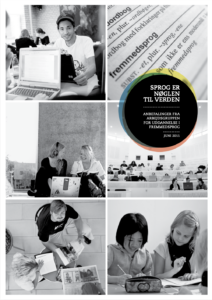
In 2011, the report Language is the Key to the World was published by the Working Group on Foreign Language Education, containing 42 recommendations. Even then, the report highlighted the declining uptake of foreign languages, the need for greater coherence between levels of education, the strengthening of linguistic and intercultural competences, and the need to incorporate language as a complementary competence within other study programmes.

The following year, the recommendations were followed up at the national conference Foreign Languages in Higher Education in Denmark, organised by Aarhus University and VIA University College. A key question was precisely how the recommendations could be implemented. Among the issues discussed were coherence and transitions from primary school to university, collaboration between educational institutions, research-based development of language teaching, and the link between language and intercultural competences and the needs of society.

In 2017, the government’s Strategy for Strengthening Foreign Languages in the Education System was published, which, amongst other things, led to the establishment of NCFF. When the strategy’s monitoring group took stock of the situationa few years later, the picture remained worrying. Among other things, it highlighted challenges throughout the entire education pathway, falling enrolment and provision, and the need for structural changes. Here, too, the opportunity to combine languages with other subject areas – language as an additional competence – was emphasised.
Viewed in this longer-term perspective, several of the issues identified by the NCFF in 2026 are therefore well known.
The need for coherence across the education system, better opportunities to choose languages, enhanced teacher competence, the link between language programmes and the labour market, and the recognition of the societal significance of linguistic and intercultural competences have been recurring themes.
This does not diminish the significance of the NCFF’s recommendations. On the contrary, this continuity can be seen as a key point in itself. When various working groups, strategies and academic communities have identified related challenges over a long period of time, it raises the question of whether the field of foreign languages today primarily lacks new diagnoses – or whether the greater challenge lies in creating the long-term political and structural follow-up needed to translate existing knowledge into lasting change.
At the same time, there are perspectives that reflect a changing societal context. Generative AI, for example, challenges our notions of what it means to be proficient in a foreign language, whilst geopolitical developments are bringing the importance of linguistic and intercultural expertise to the fore in new ways. The discussion on foreign languages is therefore not solely about preserving existing subjects, but also about rethinking which language skills Denmark will need in the future.
A further perspective that would be beneficial to incorporate into this discussion is the international dimension. The report Language is the Key to the World (2011) had already highlighted the importance of Denmark capitalising on opportunities for inspiration, knowledge-sharing and development through European cooperation in the field of languages, and specifically recommended Danish membership of the Council of Europe’s European Centre for Modern Languages (ECML). In the current geopolitical situation, this perspective seems even more relevant: the development of the foreign language sector cannot be a purely national matter, but must also be based on continued and strengthened cooperation with the ECML, the Council of Europe and other European partners.

From recommendations to action
The recommendations can therefore be seen both as a summary of the Centre’s work and as a further contribution to an ongoing Danish language policy debate. The report provides an up-to-date and comprehensive assessment and identifies specific courses of action across the education system.
However, the historical perspective also raises an important question: How do we ensure this time that the recommendations lead to long-term change?
Perhaps one of the most important lessons from the last 15 years of work in the field of foreign languages is precisely that isolated projects, strategies and recommendations cannot stand alone. A sector that functions as a coherent ecosystem also requires continuity, coordination and long-term accountability. The question, therefore, is not only which of the 13 recommendations should be implemented, but also who, going forward, will maintain a holistic view of the foreign language sector and ensure that the knowledge already built up is translated into action.

About the author: Ana Kanareva-Dimitrovska, external lecturer at Aarhus University and former development consultant at NCFF Vest (September 2018–March 2026). The perspectives and reflections expressed in this article are those of the author alone.
 Foreign Languages in Denmark in the Future: Recommendations
 How do learners make use of foreign language learning materials?
 Mr. Love and Mrs. Liberty: Does grammatical gender influence personification in abstract concepts?
 Danish democracy in English
 International Day of Sign Languages (23rd of September): What a ladybug taught me about sign languages
 The future of the Romani language