Shaetlan: a young language with old roots – a Nordic language now officially recognized

Skaermbillede 2025 10 29 112859

A Danish review of the book can be read here.

Shetland is an archipelago and it belongs administratively to Scotland. Scotland belongs administratively to the United Kingdom. The United Kingdom is liberated from the European Union, but it used to be part of the EU. The British do not feel European, at least a small majority, so they brexited. The Scots do not feel English, but they are not allowed to vote for independence. The Shetlanders do not feel Scottish, and there are a fair few who would like to have Home Rule, somewhat like the Faroe Islands have within the Danish Kingdom. There are some 23,000 people in Shetland (yes, IN Shetland, not ON Shetland). They have their …

Does he say he twice as often as she? Women, men and language

hvem sagde hvad 435087

Hvem sa hva? Kvinner, menn og språk” (English translation of the title: ”Who said what? Women, men and language”) by Helene Uri was published in Norway in 2018 and won the prestigious Brage Prize the same year. The book is about gender differences in language and language use, but it is just as much about the differential treatment and outright discrimination of primarily women, which most of the gender differences are a result of. The book is a mixed bag of observations, but still represents one of the best Scandinavian books on the topic.

Helene Uri (b. 1964) is a Norwegian linguist and author. In her 2008 novel “De besste blant os” (English translation of the …

The Danish pronoun ‘man’ used as ‘I’ in conversation

conversation 545621 12801

In English, you is both a definite and an indefinite pronoun. This means that speakers can use the same form to refer to a specific person and to refer to someone unspecific, someone in general. In Danish, the pronoun man is used to refer to someone in general, just like the English indefinite you, and the word’s primary meaning, listed in dictionaries and grammars, is this generic function. However, there are instances in the language where man occurs as an indefinite pronoun with self-reference. These instances are only briefly mentioned in the literature and are not described in detail at all.

This blog post is based on a presentation and an article from the 17th MUDS – Møderne …

A report from the “They, Hirself, Em, and You” Conference: “Nonbinary pronouns in research and practice”

image006

Back in June this year I attended a conference titled “They, Hirself, Em, and You: Nonbinary pronouns in research and practice”. It was a very giving experience, and the conference was quite unique both in terms of scholarly topic and with regards to more interpersonal aspects, so I’ve been asked to write up a brief account of the event.

image004

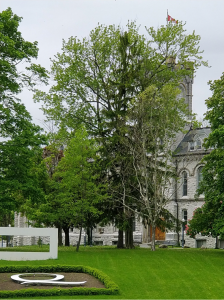
The conference, in shorthand referred to as THEY2019, took place on June 11-13th 2019 at Queen’s University in the city of Kingston in Ontario, Canada. The topic was that of (quoting from the conference website) “nonbinary gender in language, particularly in pronouns”. That is, the work presented at the conference was concerned with language used by and about nonbinary