Linguistic identity in times of crisis: The roles of the Ukrainian and Russian languages in the lives of Ukrainian war refugees

ukraine g1219b0904 1920

In Ukraine, being a bilingual who speaks both Russian and Ukrainian is such a ‘normal’ thing that many people hesitate to even call themselves bilinguals. As a Ukrainian who speaks both languages, I never really regarded this phenomenon as anything special. But after the Russian invasion in 2022, and also thanks to my linguistics studies, I noticed that the question of linguistic identity in Ukraine – and for Ukrainians in general — is a really complex, fine-grained and surprisingly under-studied area. So for the spring semester of 2025, for my sociolinguistics exam project, I decided to investigate the subconscious ideologies and attitudes that Ukrainians have towards the Ukrainian and Russian languages. When I told some of my Ukrainian friends about …

Mbessa: The Cameroonian language that refused to be swallowed by Kom

Africa Map Cameroon
Mbessa (Mbesa) is a kingdom of over 25,000 people in the Anglophone Northwest Region of Cameroon. Mbessa, like the hundreds of other kingdoms in the grassfields of the Northwest Region, is actually called a Fondom and it is headed by a powerful traditional authority called the Fon, and specifically called Foyn in the Mbessa language. It should therefore be understood that Fondom equals kingdom while Fon or Foyn equals king.

The kingdom of Mbessa was founded in the 18th century (circa 1772) by an exiled Nkar man called Tfukenu and a self-exiled Oku prince called Nsuung Nyiete (Mala 2013). Geographically, Mbessa is located between Akeh, Din, Kom and Oku, all of which are neighbouring Fondoms.

Mbessa is found in a
Lingolit II – Linguistics in the pop press

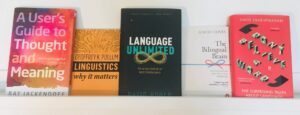
A little more than a year ago, I wrote a Lingoblog article recommending a selection of books discussing various topics in linguistics from a pop science perspective – that is, books that are about technical aspects of linguistics, but which can be understood without any prior knowledge of the field. Since these past twelve months have, for many of us, taken place largely inside the same four walls, there has (to look on the bright side) been plenty of time to read.

LingoLit2 Coverbillede 1

True to form, a handful of the books in my personal reading pile has been about language and linguistics. My previous article was sparked by my conflicted feelings about Daniel Everett’s Language: The Cultural Tool, and I …

Your brain can learn languages your whole life…

a2dc2dd7 2dde 4479 80af

– but it cannot learn languages attending language classes once a week

Back when I was a cheeky 14-or-so-year-old, I taught my mom how to say this English sentence: I am an old and ugly witch! She didn’t have a higher education, but at the age of almost 50, when most of the childbearing and caregiving was over and done with, she had decided that she wanted to learn English at a Danish evening school. Apparently, I wanted to help her out a little, and so I taught her the abovementioned phrase. Of course, I told her that it meant something completely different than what it actually does, and I succeeded in my deception, despite the fact that she had …