Shaetlan: a young language with old roots – a Nordic language now officially recognized

Skaermbillede 2025 10 29 112859

A Danish review of the book can be read here.

Shetland is an archipelago and it belongs administratively to Scotland. Scotland belongs administratively to the United Kingdom. The United Kingdom is liberated from the European Union, but it used to be part of the EU. The British do not feel European, at least a small majority, so they brexited. The Scots do not feel English, but they are not allowed to vote for independence. The Shetlanders do not feel Scottish, and there are a fair few who would like to have Home Rule, somewhat like the Faroe Islands have within the Danish Kingdom. There are some 23,000 people in Shetland (yes, IN Shetland, not ON Shetland). They have their …

Now recognized: An old language with Scandinavian roots in the North Sea

Shetland landskab

Shaetlan is a Mixed Language spoken in the Shetland archipelago, the northernmost part of the UK. As shown in the blog from 2022, it emerged due to a long drawn contact situation. There was a situation stable of Norn/Scots bilingualism. Norn was a West Scandinavian variety and Scots a West Germanic variety. This bilingualism was additionally in sustained contact with the Dutch/Low Germanic varieties. Those were spoken by those involved in the Hanseatic and Dutch fishing trades. This multilingual ecology led to Shaetlan, a Grammar-Lexicon Mixed Language with a predominantly Scandinavian grammar, but with a mainly Anglian vocabulary.

Shaetlan serves as an example after the fact for Bakker’s type of mixed languages that he calls G-L languages. These tend …

Shaetlan. A contact language in the North Sea.

image001

Shetland is the northernmost part of the UK, an archipelago straddling the Atlantic Ocean to the west and the North Sea to the east between Scotland, Norway and Faroe. The strategic location, smack in the middle of maritime trade and migration routes, means that the islands have been a place of contact for centuries, if not millennia.

Shetland has been inhabited for at least 6,000 years: the earliest evidence of human settlement in Shetland is the shell midden of West Voe dated 4200-3600 BC. These settlers were hunter-gatherers/fishers, but we don’t know when they came to Shetland or from where .

At some point around 3700-3600 BC we see evidence of a farming lifestyle in West Voe, for example that …

The Swedish Romani language, historically and today

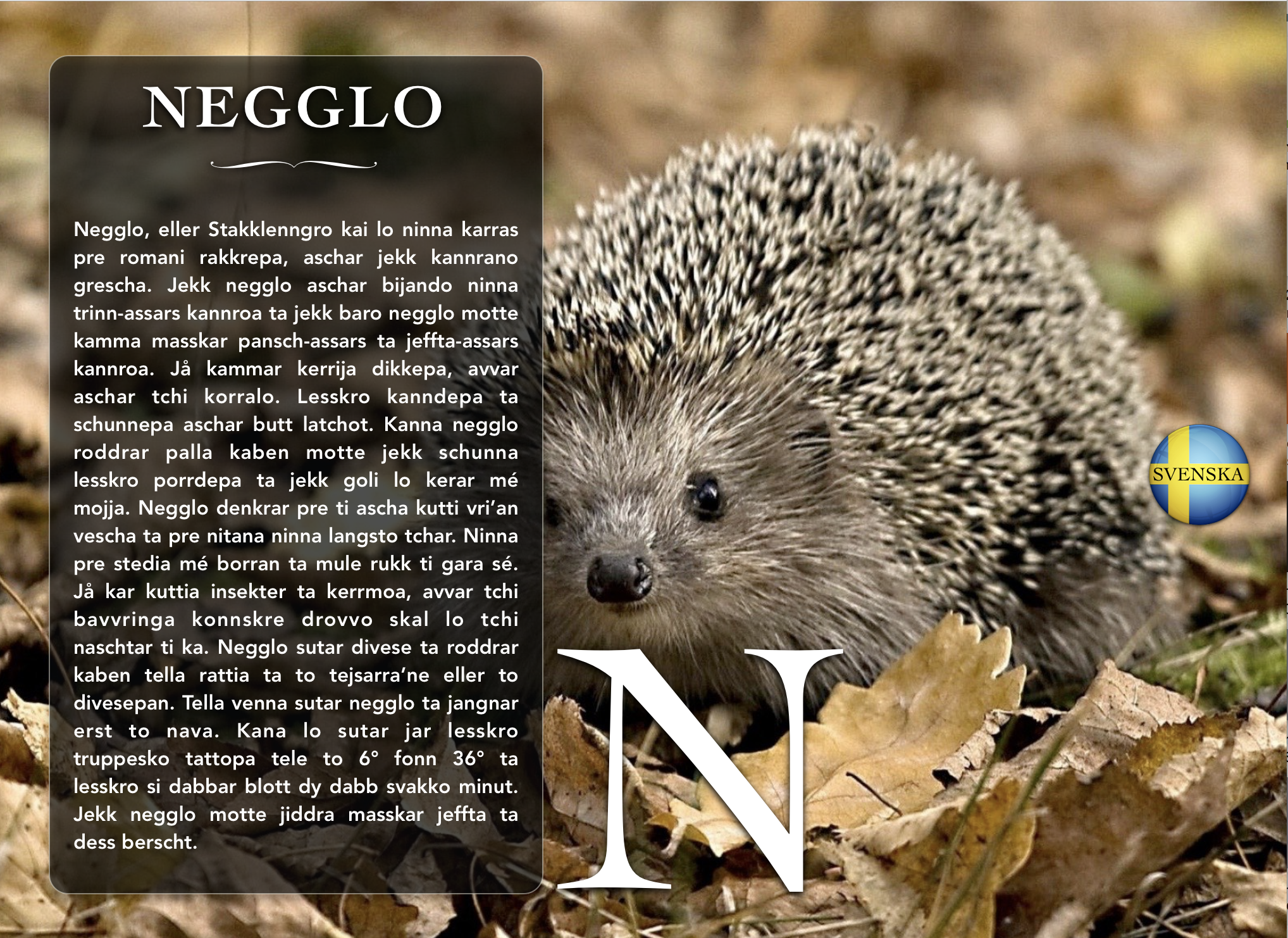
ABC LINN Negglo

Today it is World Romani Day. Jon Petterson contributes an article about his variety of Swedish Romani. 

The first known source of Romani speakers is a document describing a traveling party of a people never seen before arriving Stockholm in 1512. Originally mistaken for being Tartars they came to be called Thatra. Today the term tattare is still in use in Scandinavia. In Sweden it’s considered to be a disparaging term, but in Norway it is used as a self-definition for Romanies.

From the 16th and 17th century, the sources mentioning Romanies with the synonymous terms tartare and ziguenare are very few. In 1637 a royal decree proclaimed that Romanies should settle or leave the country within three months.